

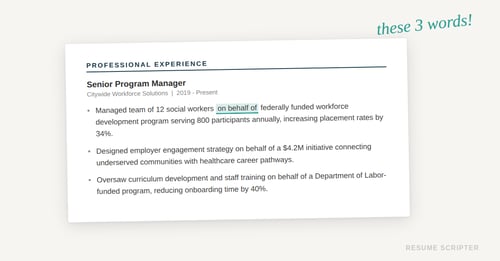
The Three Most Important Words for your Job Search
What Are We Preparing People For?
For the past few years, I’ve been creating career education resources based on assumptions I didn’t realize I had.
The intake processes that I relied on were designed for a certain kind of job seeker. Someone with a linear work history, a clean timeline, a resume that fits neatly into a format. And a lot of the people I’ve spent my career working with don’t look like that on paper. They have gaps, perhaps due to caregiving, or incarceration, or bad luck. They’ve worked across different industries, have incomplete credentials, or never moved beyond the $12/hour mark. Underlying these things, they may have valuable life experience from sources we don’t usually think to ask about.
I’ve been asking myself about the best way to guide people through this self-discovery. What I’ve found is that AI is actually really good at distinguishing situations – like when someone has limited work history but a degree – then knowing to ask them to share more about school projects and volunteer work. Or if someone was incarcerated, AI is helping me create a pathway – not a trap door – to guide them through sharing what work they did inside. Jobs like janitorial, food prep, maintenance may not seem significant to them. But if they showed up to that job for three years, that in itself says something. And they likely strengthened transferable skills they’re not seeing. We can leverage AI to help them see that – and articulate it.
But as I create and improve these tools, I'm thinking more and more about the underlying question: What are we preparing people for?
 At the foundation of our work is an assumption: that there will be quality opportunities awaiting someone who takes positive steps. And at the risk of being the career coach who claims she can tell the future, my instinct is that the mindset that will serve people most isn’t tied to any particular job function.
It's entrepreneurial.
Not in the “go raise money and launch a startup” sense, but “I can identify a problem and figure out how to address it.” Being able to act like an entrepreneur – even when working as an employee – is becoming more valuable as the corporate world gets more tenuous.
How to shift to this mindset? First, we must learn to identify the parts of ourselves that are most useful to others. Whether it’s a skill we developed, a temperament we innately possess, a way we uniquely delight the people around us – figuring out how to identify and articulate that is a core skill.
 ----
----
The job market that awaits us is going to be very different from what we’ve seen. And it’ll happen much more quickly than the shift of earlier generations – the ones who worked at the same company for 50 years – to where we are now.
Before, we had to let go of the idea that an employer owes us loyalty. Now, we have to let go of the assumption that anyone owes us a job, that we should expect someone else to figure out how to profit from our skills.
This sounds daunting, but the tools to do it have become ridiculously accessible. I'm in an AI accelerator program right now with 20 other companies, mostly bootstrapped, all working on solving a pressing problem they identified.
And while I'm not saying the full-on path of a struggling entrepreneur is for everyone, I think learning to cultivate this way of seeing ourselves - as capable of being the bringer of solutions - will be core to what awaits us.
How can we prepare? By instilling in the people we work with an appreciation of their ideas and strengths. By making the education that surrounds all of this more accessible to them. And I don’t just mean medical billing, customer service, or data analytics. Those are job functions. I mean teaching people how to take an idea they believe in, vet it, and see it to fruition.
I'm not at all dismissing the skilled trades. I did an 18-month cabinetmaking degree in my 20s, and it could be argued I learned more valuable skills in that program than in my master’s degree. But I think built within all of these pathways and programs should be a consideration of the question: How would someone learning these skills strike out on their own?
We can’t rely on private companies to consistently furnish opportunities, and to keep our participants steadily and gainfully employed. Aside from a select few, they’re working as fast as possible to automate everything they can. But on the flip side, the tools and methods they’re applying are accessible to anyone.
We can be teaching people how to take the skills of production into their own hands.
-----
Note to my community: I’ve been working on conceptualizing an AI course where job seekers learn to identify a problem, build an AI-powered solution, and monetize it. If that sounds interesting - for you or for the people you work with - I’d love to hear from you!
If you found this post insightful, consider sharing it using a link below:



Andrea Gerson, MSW, CPRW, is the founder of Resume Scripter and RS Works, an AI-powered career development platform that has helped more than 50,000 jobseekers communicate their professional value. She has trained over 3,500 career coaches through U.S. Department of Labor partnerships and spent eight consecutive years as the #1 resume writer in NYC on Yelp.